
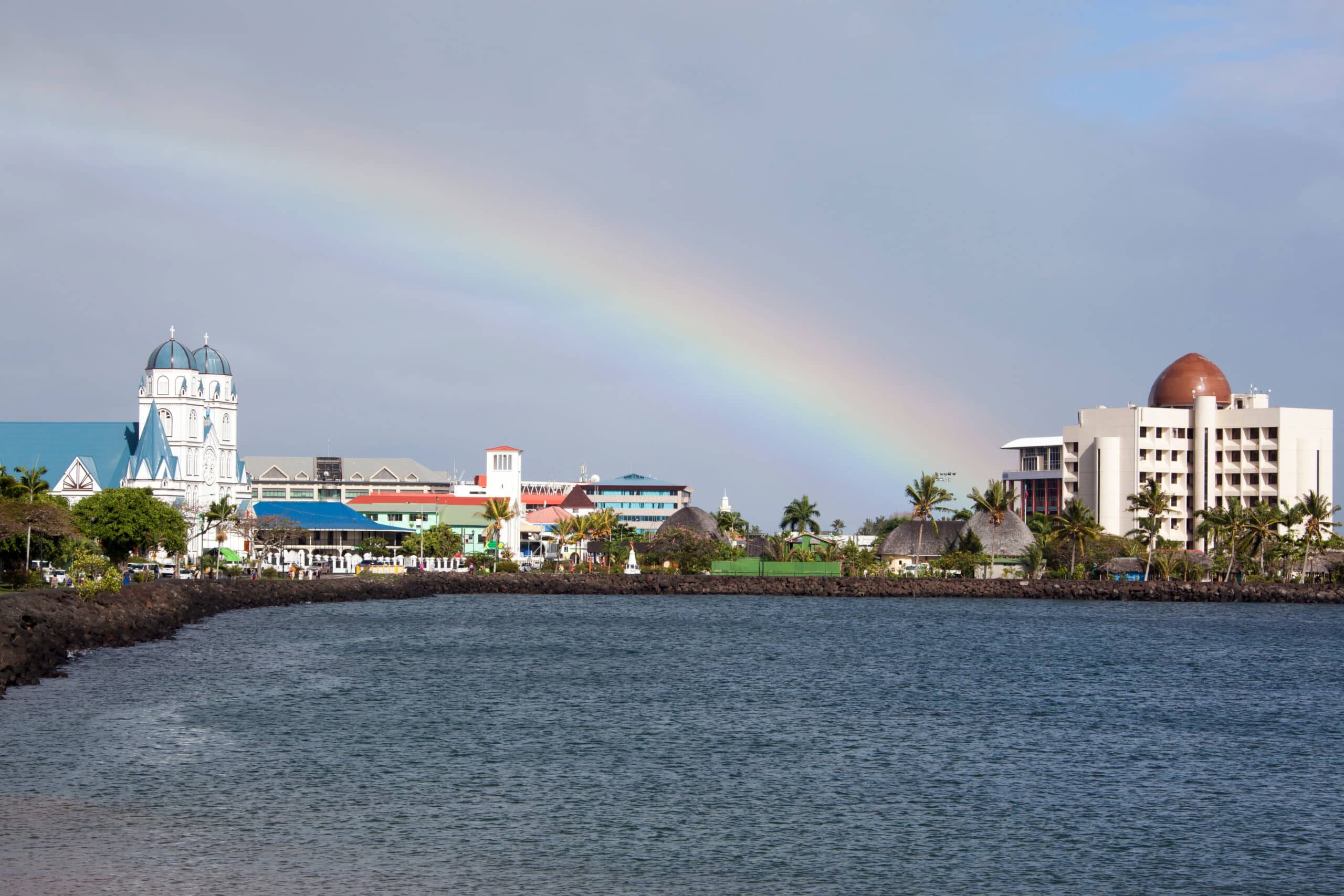
From August 11–19, 2026, the Pacific Island country of Samoa hosted the 22nd annual meeting of the Western and Central Pacific Fisheries Commission (WCPFC) Scientific Committee (SC) in Apia. This was my first time attending an SC meeting, so I came into it knowing the science, but with a lot less understanding of how the Commission and its processes actually works. I’m comfortable with stock assessments, sampling design and statistical bias. I’m much less familiar with procedural rules, every changing agendas and the intricacies of paper designation numbering. Most confusingly, the choreography of who gets to speak when, and the polite, legal language in which everyone speaks. After the last few days, I have a much better appreciation of just how much procedure sits between good science and an actual decision that might help conserve a shark.
The sheer volume of reading material is hard to explain unless you’ve been sitting in the room. By my count, there were more than a 200 papers in all, of which a dozen were directly about sharks and rays, or about the data issues that determine whether we can say anything reliable about them in the first place. There were coverage statistics buried in appendix tables, biological sampling programmes reporting essentially empty specimen banks for entire species, ecological risk assessments ranking more than two dozen elasmobranch species by vulnerability, and cost-benefit analyses of genetic sampling methods that, until now, I’ve mostly only thought about from the methodological and lab side. And that’s before getting to the roughly 160 other papers that could have implications for sharks and rays. These included tuna stock assessments that will ultimately influence how many sharks are caught, as well as proposals such as circle hook requirements for sea turtles that will also have benefits for shark conservation.
Trying to read all of this before the meeting was, honestly, pretty overwhelming. Even though this is the sort of science I work with every day, the scale of what the Committee has to consider (in a relatively short period of time!) is huge. Watching delegates and Committee members work through it all in real time, across dozens of species and fisheries well beyond sharks, gave me a new appreciation for what this Committee is actually being asked to do every August!
What surprised me more than the science, though, was the process. There were a couple of papers this year looking at how the Scientific Committee manages and prioritises its own workload. On the surface, these are pretty dry procedural discussions. But they could actually have a big influence on how often shark issues get discussed over the next few years. Whether a review happens on time or gets pushed back by a meeting or two can come down to discussions about prioritisation cycles and terms of reference, rather than anything to do with the biology and status of oceanic whitetip sharks.
I understand much better now why Sharks Pacific puts so much effort into engaging with the Commission itself, and not just doing the field based science that most people find most interesting.
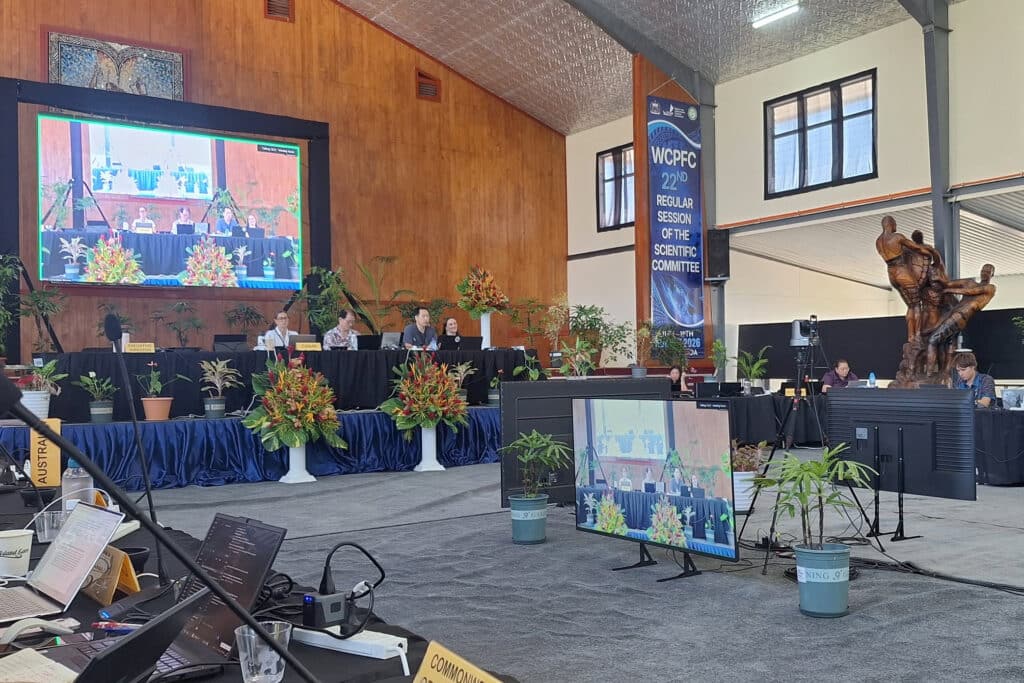 I also learned a lot from watching our Policy Director, Bubba Cook and colleagues from other NGOs and country delegations work the room. Bubba has been involved with this Commission for years, and that experience and the respect people in this meeting have for him really shows. Not through anything particularly dramatic, but through the small things: a hallway conversation with an SPC scientist about a table buried in an annex, the nods around the room when Bubba makes an intervention, or country delegates stopping by our observer desk to flag something they think we might have missed, or asking Bubba for advice on how to best get recommendations across the floor.
That trust doesn’t just happen overnight. It gets built up meeting after meeting by consistently showing up, knowing the papers, listening to people and taking fair-minded positions rather than just making noise. In a process this dense and complicated, that trust can make the difference between a good scientific recommendation making it into the final report or disappearing somewhere along the way.
And that matters. If there isn’t agreement around the science, and if that agreement isn’t reflected in the meeting record, there is much less to build on when the Commission eventually gets to making the policy decision to support shark and ray conservation at subsequent meetings.
What We Focused On
A few themes came up repeatedly in our position statement and interventions this year:
- Fisheries observer coverage and bias: A paper from The Nature Conservancy and the University of Tasmania put some hard numbers behind something we’ve been arguing for years: anything short of full 100%, independent monitoring coverage of the longline fleet creates a systematic bias towards under-counting catch and bycatch. Importantly, the bias is greatest for the species we’re most concerned about, relatively rare, incidentally caught species such as sharks and rays.
- Systemic data gaps: The Commission’s own scientific data paper confirmed that under-reporting of key shark species remains a recurring gap across essentially every major catch and effort data source the Commission relies on. We used our intervention to push for the improvements recently made to discard reporting to be extended to sharks, for inconsistencies between retained and discarded catch reporting to be fixed, and for a gap in the compliance scoring system that currently allows incomplete shark data to effectively pass as full compliance.
- High seas transshipment: We again raised transshipment (where fishing boats transfer catch between boats in international waters – creating a shell game rife with Illegal and Unreported Fishing) as a major, and still underappreciated, scientific blind spot. Transshipment is overwhelmingly associated with the same longline fleet that is subject to only (a longstanding and clearly inadequate) 5% minimum observer requirement. The Commission still has no reliable way of knowing what species, including which sharks and rays, are moving through that pathway.
- Data poor shark species and getting no better: New papers this year showed that shortfin mako, oceanic whitetip, silky shark and blue shark all need substantial additional data before newer approaches such as close-kin mark-recapture (where genetic samples can be used to estimate size of population) can realistically be used. We also saw how non-retention rules can create their own problems by making it harder to collect the biological samples that future assessments will need.
- Scientific process reform: We supported, with some conditions, proposals to rationalise and streamline the Committee’s workload. At the same time, we pushed for a clear limit on how far a review of the Commission’s core shark conservation measure (CMM 2025-06) can be postponed. We also argued that the discussion around funding and resources for shark and ray science needs to happen alongside the scheduling discussion, rather than being left until afterwards – and inevitably abandoned due to limited available funding.
Bubba delivered two interventions on the floor over the last few days reflecting these priorities, specifically one on the systemic data gaps and one on the observer bias and monitoring coverage findings, and we’ll continue to press these points as the session concludes and moves toward the Technical and Compliance Committee (TCC – where the science we discussed here is used to shape the policy and compliance of participating countries) in Pohnpei, Federated States of Micronesia, next month.
The Bottom Line
I came away from my first SC feeling a bit intimidated, but also pretty encouraged. Intimidated by the sheer amount the Commission has to keep track of at once, and by how easily a well-supported scientific point can get lost in a discussion about scheduling, workload or funding if there isn’t someone in the room to keep bringing it back.
But encouraged because that is exactly the role Sharks Pacific is trying to build the credibility to play.
The science around shark data gaps and observer bias is no longer really contested. It is documented and quantified, and this year some of the strongest evidence has come directly from the Commission’s own science providers and independent researchers, rather than from advocacy groups like us.
The harder part is what comes next: making sure that evidence survives the process long enough to actually become a decision.
That’s probably the biggest thing I’m taking away from Apia. Good science is necessary, but it’s only one part of the job. You also have to understand the process, build relationships, keep showing up and be willing to work through the really tedious, procedural stuff.
It’s a long game for sharks. After this week, I have a much better idea of what that actually looks like, and I’m glad to have been a small part of it.