

Every year, many miles from any shore, fishing vessels stationed in the Pacific Ocean offload hundreds of thousands of tons of tuna to carrier ships.[1] These ships are the delivery trucks of the fishing industry. Often owned by the companies doing the fishing, they are built differently than fishing vessels and cheaper to operate. Their focus is singular: moving products across entire oceans.
The carriers visit multiple vessels, dropping off supplies of food and fuel, then collecting their catch and hauling it to bustling ports in China, perhaps, or Taiwan or Korea, where it gets loaded onto trucks bound for auctions and processing plants.[2] This is business as usual; problems, however, arise when fishing vessels have no reason to go ashore, where officials might inspect their holds.
Transferring fish between vessels, far away from a port, enables unreported fishing, shark finning, forced labor, and outright theft. In the markets and high-end restaurants where people buy tuna, no one has to know it was caught with critically endangered animals, stolen from poor island nations, and processed by modern-day slaves. Sharks Pacific’s Executive Director Jess Cramp describes transshipment at sea as the nexus of evil in the ocean.
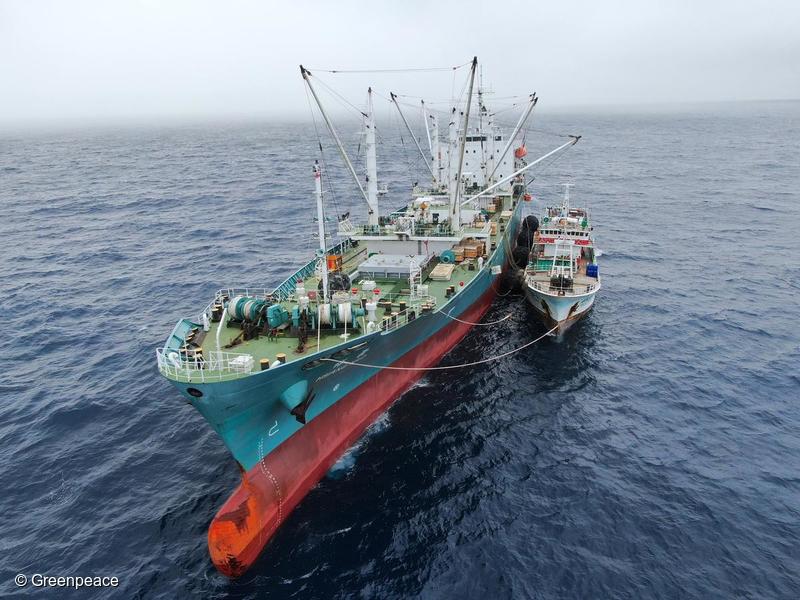
Transshipment, broadly, refers to the act of moving products to a holding place – another truck, perhaps, or another port – before they reach their final destination. Transshipment at sea involves transferring catch from one vessel to another.
Fishing companies rely on the practice because they have fleets licensed in distant waters, weeks away from their home ports. Sending carriers to gather their catch reduces costs and travel time for boats built and staffed to focus on fishing.
Both of the vessels involved in a transshipment are supposed to be licensed and to report what changed hands, and how much. Observers paid by governments or regional organizations are supposed to be on board observing the exchange, too. But most transshipment occurs without any oversight, in flagrant disregard of the rules. For eight of the months of 2025, no observers in the world’s largest tuna fishery filed a report.[3] Even when there are observers on board, it’s difficult to verify the independence of their observations. Some accept payment from fishing companies to skew reports. Some are members of the fishing crews they are observing. Others intend to report violations and disappear at sea, dying uninvestigated deaths.
Without eyewitness accounts, governments and regional organizations have to rely on logs kept by fishing companies, satellite tracking, and inspections by patrol boats or port authorities to understand what’s being transshipped. But while satellites can prove that two vessels were together, they can’t prove whether fish, or shark fins, or humans, changed hands. Inspections are likewise an imperfect solution. Crews can process their catch until it’s unrecognizable, then mislabel it as an unprotected, or less protected, species, a deception that would take inspectors weeks to investigate. They can mix legal and illegal fish, then freeze them into giant, inseparable blocks. Carriers can also offload their deliveries at ports where authorities are known for their leniency toward corporations domiciled in their country.[4]
Aboard ships that don’t have to pull into port, a lawlessness persists. Captains work their crews like slaves. Workers in poor communities across Asia are lured by the promise of decent wages, then trapped at sea and forced to fish. Some are at sea for years, fishing from the decks of floating prisons. They endure long hours, beatings, hunger, and thirst.[5]
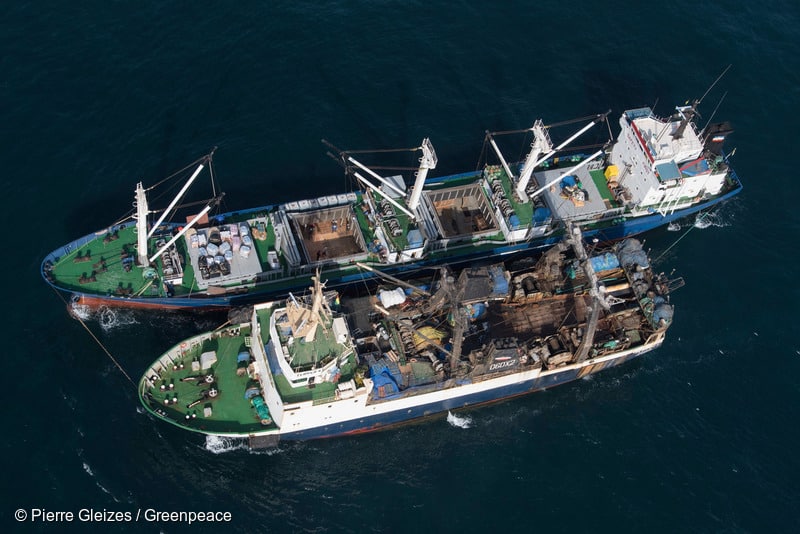
Transshipment at sea began as a solution to a business problem. At the time, the oceans were largely ungoverned.
By the middle of the twentieth century, advances in technology had birthed a new apex predator: the industrial fishing machine. The resources of the ocean were free to whoever could reach them first. Fleets from countries such as the Soviet Union, Japan, Taiwan, and South Korea traveled thousands of miles to Africa and the Pacific to catch fish.
Boats deployed nets a mile wide and lines 60 miles long that removed fish from the ocean at an unprecedented pace. To keep up, fishing companies began using refrigerated cargo vessels to fetch and ferry their catch.
In 1982, after nearly a decade of stymied negotiations, the United Nations passed what’s known as the Law of the Sea. The agreement created exclusive economic zones, or areas stretching 200 miles offshore in which governments could claim and manage resources.[6]
Now Pacific Island nations could monetize access to their fisheries, which were and are some of the most productive on the planet. This was a landmark decision; per the United Nations, 90% of the world’s fisheries are now under national jurisdiction.[7]
Fishing companies purchased licenses from island governments. They also trained their focus on the high seas. Regional fisheries management organizations formed in response. In the world’s largest tuna fishery, 25 Pacific Island nations and the nations interested in their ocean – China, Japan, South Korea, Taiwan, the U.S., and the E.U. – agreed to cooperate. Their agreement became the Western and Central Pacific Fisheries Commission.
The commission ruled, in 2009, that transshipment on the high seas is “generally prohibited.”[8] The rule was accompanied by an important caveat: the government that registered a vessel, known as its flag state, may file an exception for that vessel based on some very specific criteria.
Exceptions get made, and violations go unpunished. If a boat does anything illegal on the high seas, its flag state is responsible for its prosecution. Often, this is a country half a world away, where the fishing company pays tax.
Despite restrictions, in 2025, carrier vessels transshipped a quarter of line-caught albacore tuna, a third of bigeye tuna, and 37% of the yellowfin caught in the international waters of the Western and Central Pacific Ocean.[9]
For people on islands, fish is more than a line item in a budget. It’s currency and livelihood; it’s also heritage. People in the Pacific have been surviving on fish and seafood since long before anyone drew lines across a map.
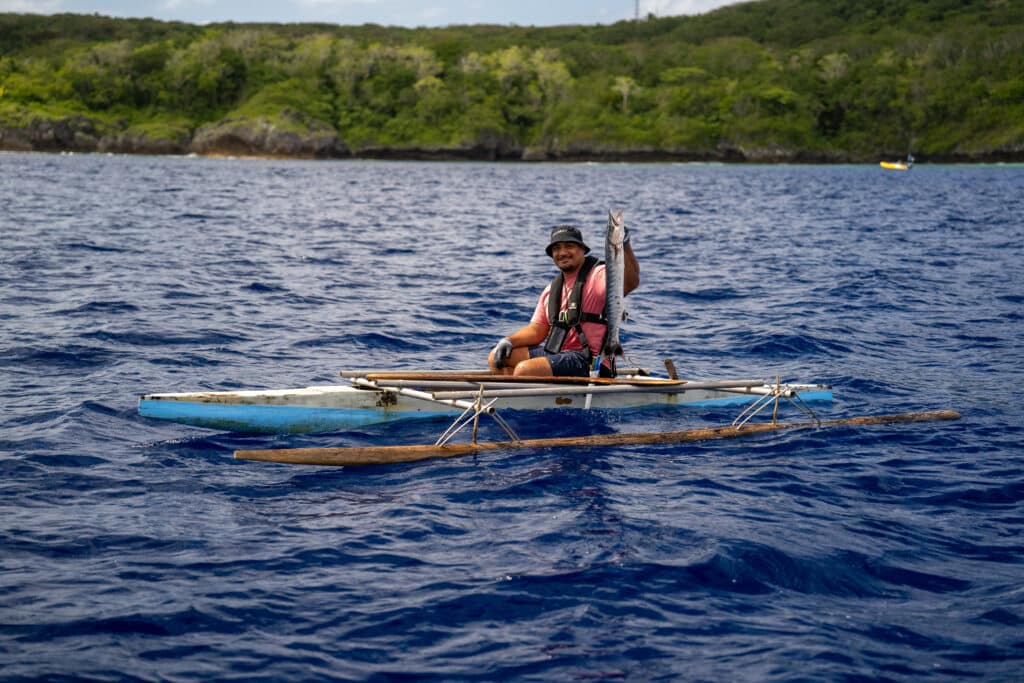 Some islands get a visit from a cargo ship annually, or twice yearly, and people who live there eat fish in the months between. Some islands don’t get cargo ships at all. When the COVID-19 pandemic ground tourism to a halt, people in the Pacific survived by eating from the ocean.
Fishers in the Pacific talk about how fishing has changed. They report having to go out farther and for longer to catch less than they used to. On many islands, fish goes to the resorts first; what’s left quickly sells out.
Communities are watching their fish become less abundant and more expensive. They hear and read that climate change is the culprit, but they also see the lights of the big boats on the horizon in the dark of night.
Island leaders have to balance what scientists are saying about declining fish populations with their responsibility to generate revenue for hospitals, schools, and roads. So, they sell access to their fisheries. In order to control the outward flow of fish, they impose the quotas and limits negotiated and published by regional organizations.
Small governments use their small budgets to cover the cost of enforcing laws within immense oceans. Imagine removing a police force from its city, installing it in a building a three-day drive away, and instructing its officers to prosecute crimes, but only if they can arrive at the scene before the criminals flee. This is, in essence, what’s happening in the Pacific, where great distances separate authorities and the fishing grounds they manage. Some countries have a single patrol boat.
On remote islands, where people have lived in isolation for centuries, careful management of natural resources is a living history. Conservation is baked into the languages and cultures of the Pacific. Island people have long understood that, for a field or a fishing ground, rest is essential to recovery. On some islands, overharvesting was once punishable by death. From the perspective of Pacific governments, transshipment at sea is like selling someone a cart full of precious items, then learning later they took a few more cartfuls on the way out.
For decades, island leaders have been asking the Western and Central Pacific Fisheries Commission for tighter controls on transshipment in the high seas. What happens in neighboring waters affects their fisheries, too, because fish don’t heed borders. In 2009, delegates from the Republic of the Marshall Islands and Nauru proposed what would become known as CMM 2009-06, a measure that defines transshipment at sea as the exception rather than the rule, permitted only when absolutely necessary. It also mandates that fisheries observers witness all transshipments.
The commission tasked a working group with finding ways to enforce the measure. In 2024, the group dissolved, deadlocked. Global leaders in a fishing industry worth $186 billion (US) in 2024, the latest year for which the Food and Agriculture Organization of the United Nations published data, tend to prefer policies that go easy on transshipment.[1]
Science and technology can and do fill some of the cracks in the system of regulating transshipment at sea. Satellites track vessels’ locations. Some boats are now reporting their catch electronically. Software can scan for mismatches in data logged at sea, during a transshipment, and in port. Coastal states, or countries with oceans to manage, get quarterly updates about what’s been transshipped. A team of researchers recently developed a handheld DNA test that authorities can use to identify within two hours whether a catch contains any protected shark species.
And yet, the cracks in the system remain. Researchers estimate that because of transshipping at sea, coastal states and fishers are losing between $10 and 23.5 billion (US) every year.[12] While negotiations stall, people, the planet, and developing countries lose lifeblood.
Sharks Pacific supports the Pacific leaders calling for an outright ban on transshipment on the high seas. Technically, the ban already exists, but it is not difficult to claim to need an exception, so we are advocating for stricter policy. We believe that shark conservation is undermined by transshipment on the high seas. While our organization would support the practice of transshipping under more careful scrutiny, the stakes are too high and the pace of change is too slow to justify a conservative stance on this issue.
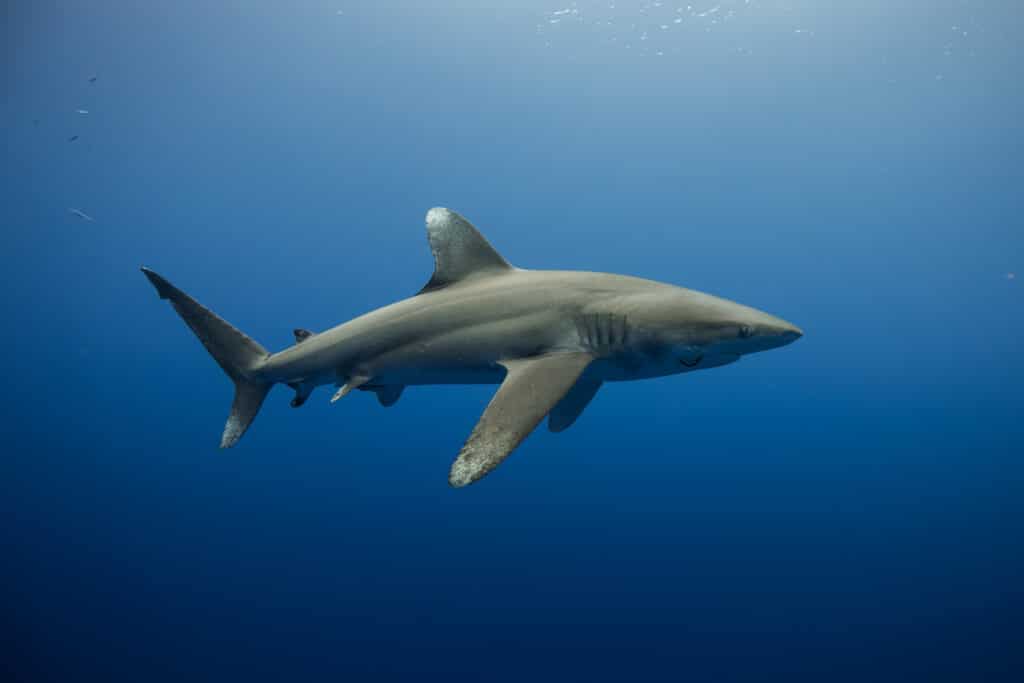 If you study sharks, you know what goes wrong when fishing fleets take too much, too fast. Shark species targeted for their valuable meat, liver oil, and fins are critically endangered. The population of oceanic whitetip sharks in the Pacific, for example, has shrunk by up to 95% since the mid-1990s.[13]
We know what could go wrong if we allow transshipment on the high seas to continue. We are asking a different question: what if we can rally the support to end the practice? What if requiring vessels to go ashore frees enslaved laborers? What if it means island governments can sell access to their fisheries without worrying fleets will take more than their allotted share? What if fish and shark populations rebound? What could go right?
Most problems require individualized solutions. Enforcing a ban on transshipment on the high seas is a silver bullet that relieves pressure on sharks, fish, island economies, and people forced to work in abysmal circumstances at sea.
Transshipment on the high seas occurs in the middle of the ocean, beyond the reach of authorities. A port transshipment occurs when vessels are either in a port or in a designated area at sea within a country’s exclusive economic zone. In this type of transshipment, officials in that country have the authority to board vessels to inspect and verify reported catch.
Shark finning is the practice of catching a shark, slicing off its fin, and disposing of the rest of its body. In order to curb this brutal form of fishing, states and regional organizations have passed laws against it. Transshipment at sea allows fishing crews to circumvent these laws in various ways. One way is by mixing shark fins into other products to hide them; another is by blending catch from multiple vessels, thus obscuring the ocean and vessel the shark fins came from. When transshipments occur with little or no oversight, or away from designated ports, no one is there to effectively monitor whether shark fins are onboard and whether they’re from critically endangered species.
The rules vary between oceans, but in most cases, it’s allowed when necessary. This creates a loophole for companies to enter through; often they can claim it’s essential to transship at sea without having to provide any further data.
The Western and Central Pacific Fisheries Commission’s annual report on transshipment for 2026 says 243,427 metric tons of migratory fish were transshipped in 2024, the most recent year for which scientists with The Pacific Community had data.
[1] Annual Report on Transshipment Monitoring, WCPFC, July 2026
[2] Annual Report on Transshipment Monitoring, WCPFC, July 2026
[3] Annual Report on Transshipment Monitoring, WCPFC, July 2026
[4] Spotlight On: Laundering Illegally Caught Fish At Sea, TMT, 2026
[5] “The Crimes Behind the Seafood You Eat,” The New Yorker, 2023
[6] UN Convention on the Law of the Sea, Article 55
[7] “20 Years of Law and Order on the Oceans and Seas,” Division for Ocean Affairs and the Law of the Sea, 2002
[8] Conservation and Management Measure 2009-06
[9] Annual Report on Transshipment Monitoring, WCPFC, July 2026
[10] Annual Report on Transshipment Monitoring, WCPFC, July 2026
[11] The State of World Fisheries and Aquaculture 2026
[12] “At-sea transshipment of fishery catches: a systematic literature review,” Frontiers in Ocean Sustainability, 2026