

Over 600 million hooks enter the Pacific Ocean from longliner fishing vessels every year. Independent observers witness what happens on just 5% of those vessels. The rest? Invisible. And yet, fisheries observers have one of the most important jobs in terms of shark conservation.
Observers live and work aboard fishing vessels, recording catch, effort, bycatch, and compliance with rules. They provide unbiased data for stock assessments and ecosystem research, and document possible violations. Their presence deters non-compliance and improves accuracy beyond self-reports. In the vast and remote waters of the Western and Central Pacific Ocean, observers are also often the only independent eyes and ears who see first-hand when sharks end up as by-catch, when protected shark species are fished, and when shark finning occurs. Without observers on board, these actions are virtually invisible.
Since 2012, the Western and Central Pacific Fisheries Commission (WCPFC) – where Sharks Pacific conducts its fisheries advocacy work – has required only 5% observer coverage on longline vessels. That means for every 20 fishing trips, independent observers witness just one. To put this in stark numbers: roughly 2,000 longline vessels are dropping hundreds of millions of hooks a year into the Pacific, generating $1.6 billion in catch value, and the overwhelming majority of it happens without a single independent witness.
The independence – meaning no financial or institutional ties to the fleet being monitored – of fisheries observers is critical for accurate reporting data. But this independence is more difficult to achieve in practice: Observers are frequently from the same country as the fleet they’re watching. They’re sometimes paid by the vessel operator. In some cases, they’ve served as crew on the same boat they were supposed to be monitoring. And, observer harassment, threats, and even death are well-documented, making their jobs one of the most dangerous at sea.
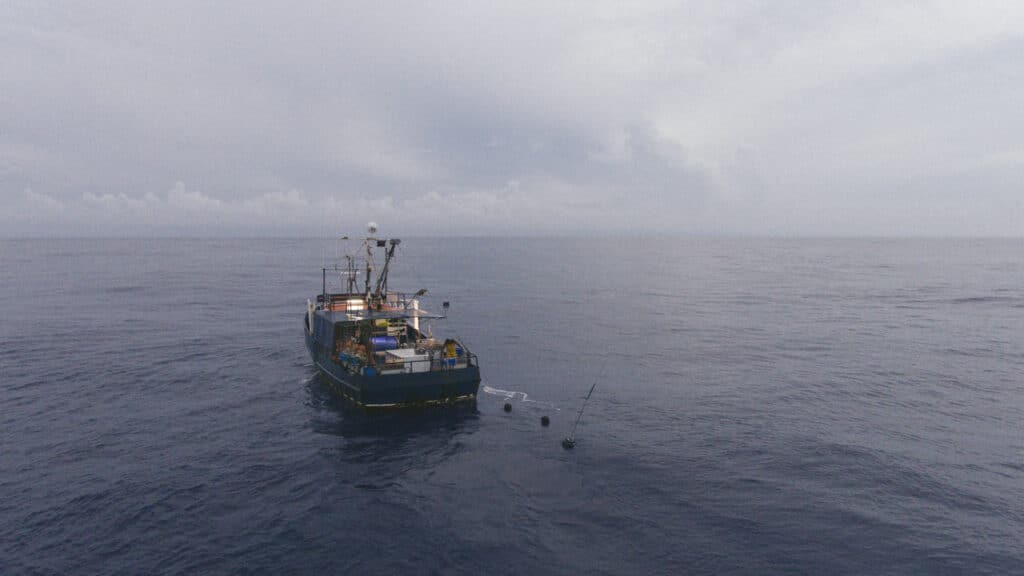
Electronic monitoring (EM) has been touted as a potential cost-effective and decidedly unbiased fisheries monitoring solution. EM devices might include cameras, GPS units, and sensors installed on fishing vessels. The addition of AI-assisted video review could accelerate EM technology’s potential: rather than requiring a human to watch thousands of hours of footage, machine learning systems can now scan video automatically, flagging incidents for review and generating near-real-time data at a fraction of the cost. That said, EM has real limits and may be best used in conjunction with a human observer. For example, on-deck cameras can’t see a shark cut from the line underwater. In addition, AI is only as good as its training data, and for many shark species, that data is thin. Finally, who owns and controls the footage remains contested.
Fisheries observers are essential to healthy shark and ray populations but the system has real gaps: observers are too few, not always fully independent, and sometimes working in conditions that compromise both their safety and their data. Electronic monitoring and AI can serve as supplementary or complementary tools. The WCPFC has already proven that high coverage is achievable: purse seine vessels have operated under a 100% observer requirement since 2010. Extending that same standard to longline fleets, where sharks are caught, discarded, and unreported beyond anyone’s view, is the logical next step.