

Sharks and rays have been part of human history, myth and culture for millennia. [1] In coastal communities shark meat is an important part of everyday life, from providing essential protein to economic livelihoods, and with shark and ray fisheries accounting for up to 80 percent of income in some vulnerable coastal communities. [2] Moreover, sharks are keystone species. As apex predators, they maintain a healthy and balanced ocean ecosystem, transport nutrients, and contribute to carbon sequestration. Rays on the other hand act as ecosystems engineers. They oxygenate seafloor sediments, regulate oceanic food webs, and also sequester carbon.
However, in the last 21 years, the global trade in shark and ray products has nearly doubled in demand, expanding from shark fins, to meat, gill plates, liver oil, and skin. [3] [4] In 2025, this market was worth nearly $1 billion annually. [5]
As global demand and value of shark and ray meat increases, their populations face steady decline due to overfishing in industrial fisheries either through targeted catch and/or bycatch. [6] Although global, regional, and national level efforts have been taken to improve shark conservation, seafood traceability remains opaque, allowing shark meat to be sold under vague and sometimes misleading labels.
 For example, in 2025, a University of North Carolina at Chapel Hill study uncovered that critically endangered sharks, such as the great hammerhead and the scalloped hammerhead, are sold in U.S. grocery stores, seafood markets, and online stores under a vague label of “shark.” [7] [8] Similarly, mako sharks, which are frequently caught as bycatch in tuna fisheries, are often sold as “swordfish” due to similarities in their meat texture and color. It should be noted that mako sharks are listed in CITES Appendix II due to their endangered status and therefore trade of their meat should be strictly regulated. A separate study by the University of Exeter in the UK found in 2019 that fish and chip shops were selling spiny dogfish, a shark species classified as endangered in Europe, under generic names such as huss, rock, flake and rock salmon. [9] In all cases, incorrect, vague, and colloquial labeling of shark meat limited consumer insight into what they were eating and how it got to their plates.
So, how does endangered shark meat end up in your grocery store?
The voyage of shark meat to your grocer’s shelf begins on the fishing vessels. Lack of observers on fishing vessels and incomplete record keeping of the catch and bycatch pose a monumental challenge to seafood transparency. The Western and Central Pacific Fisheries Commission (WCPFC) only requires five percent of longliner vessels, which account for most fishing vessels, to have observers. [10] [11] Being an observer on a fishing vessel is an extremely dangerous job, with some observers facing harassment, assault, interference, coercion, and even fatalities as they try to monitor and record catch data on commercial fishing vessels oftentimes engaged in illegal fishing. [12] However, the WCPFC has adopted Electronic Monitoring (EM) standards to augment observers in 2024 and is working to achieve higher rates of observer coverage through EM on longliners. [13] [14]
Transshipment on the high seas also obfuscates accountability and transparency on shark bycatch. [15] Although transshipment is a legal practice, some fishing vessels abuse the practice in international waters to stay at sea for months or even years at a time, enabling delinquent actors to carry on without reporting their catch. [16] According to PEW Research, at least $142 million worth of tuna and tuna like species are moved in illegal transshipments each year in the Western and Central Pacific Ocean (WCPO) alone. [17] When ship to ship transfer occurs, especially when multiple ships are involved, the origin of the shark meat is lost because catch from different ships are combined in one storage area.
Once on land, the catch is often sent to a processing plant, where it’s cleaned, filleted, slated, smoked, and packed. [18] At the processing plant, the catch from different vessels and sources commingle on the conveyer belt and throughout the processing plant. It is not unusual for fish caught in international waters to be sent for processing in one country and then sold in a third country. [19]
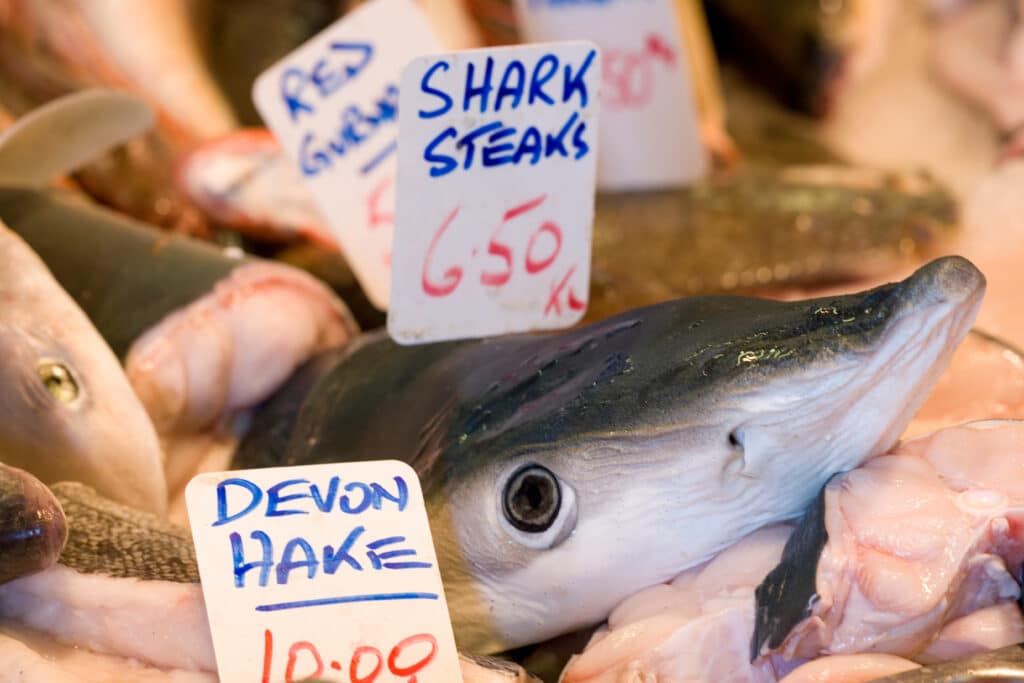
From the processing plant, shark meat is distributed to various retailers and customers locally, nationally, and globally, which is then subject to different regulatory codes based on location. Most countries support landing the whole shark with full fins attached to stymie the global shark finning* trade, while others have banned shark fishing in coastal waters. [20] Unfortunately, evidence in recent years suggests that increase in shark finning and associated obligation to ensure full utilization of the shark has contributed to growth in commercial shark meat trade. [21] Similarly, shark meat labeling varies by region or country. In the U.S. labeling shark meat as “shark” is sufficient; however, European Union regulations mandate labeling to include specific shark species. Regional colloquial terms such as rock salmon, flake and rock eel, among others, can further complicate identifying shark meat for consumers. [22] [23]
And this is how we get sharks on shelves.
On a macro level, Sharks Pacific is advocating strengthening requirements in CMM 2024-05 to ensure shark fining does not occur in the WCPO and for heavy reforms for at-sea transshipment to ensure bycatch transparency and eliminate illegal, unreported and unregulated fishing. On an individual level, awareness of the fishing industry and challenges in seafood traceability is the first crucial step. In the U.S., seafood certifications from Marine Stewardship Council and Monterey Bay Seafood Watch for wild fisheries are useful when looking for sustainably sourced seafood at the grocery store. [24] However, these certifications are not universal; therefore, small steps such as asking questions such as “where did this fish come from?”, “what is the specific species of this fish?” and buying from local fishermen can go a long way to fostering change in seafood transparency and shark conservation.
* Shark finning is the process of taking the fins of the shark and discarding its carcasses.
[1] Finding the dried sharks of Angola – Save Our Seas Foundation
[2] A Third of Sharks, Rays and Chimaeras are Threatened with Extinction, as New Report Narrows in on Solutions | Center for Coastal Studies
[3] Demand for shark meat doubles despite species extinction threat – Oceanographic
[4] Critically endangered shark being sold as food in US grocery stores – Oceanographic
[5] The $1-Billion Shark Trade: Can Conservation Keep Up?
[6] Critically endangered shark being sold as food in US grocery stores – Oceanographic
[7] Frontiers | Sale of critically endangered sharks in the United States
[8] Endangered shark meat is being sold under misleading labels in the U.S., study finds – CBS News
[9] UK fish and chip shops are selling endangered sharks, DNA tests prove | Sharks | The Guardian
[10] ISSF Welcomes Strong Outcomes for Western and Central Pacific Ocean Tuna Fisheries at Management Meeting, including the Adoption of Minimum Standards for Electronic Monitoring – International Seafood Sustainability Foundation
[11] Tuna Fisheries Would Benefit From More Onboard Observers, New Research Shows | The Pew Charitable Trusts
[12] Fisheries observers: An overlooked vulnerability for crime and corruption within the global fishing industry – ScienceDirect
[13] Electronic Reporting and Electronic Monitoring – IWG | Western and Central Pacific Fisheries Commission
[14] ISSF Welcomes Strong Outcomes for Western and Central Pacific Ocean Tuna Fisheries at Management Meeting, including the Adoption of Minimum Standards for Electronic Monitoring – International Seafood Sustainability Foundation
[15] oceana_transshipping_exposed_report_final_0.pdf
[16] Most Global At-Sea Transshipment Involves a Small Group of Key Carriers | The Pew Charitable Trusts
[17] Global Transshipment | The Pew Charitable Trusts
[18] Improve traceability | Seafood basics | Seafood Watch
[19] Improve traceability | Seafood basics | Seafood Watch
[20] International Shark Protection Measures | Animal Welfare Institute
[21] Market incentives for shark fisheries – ScienceDirect
[22] Determining the Authenticity of Shark Meat Products by DNA Sequencing – PMC
[23] Study finds meat from critically endangered shark species being sold in US grocery stores | SeafoodSource
[24] What Are Seafood Certifications? | Sustainable Seafood – Fulton Fish